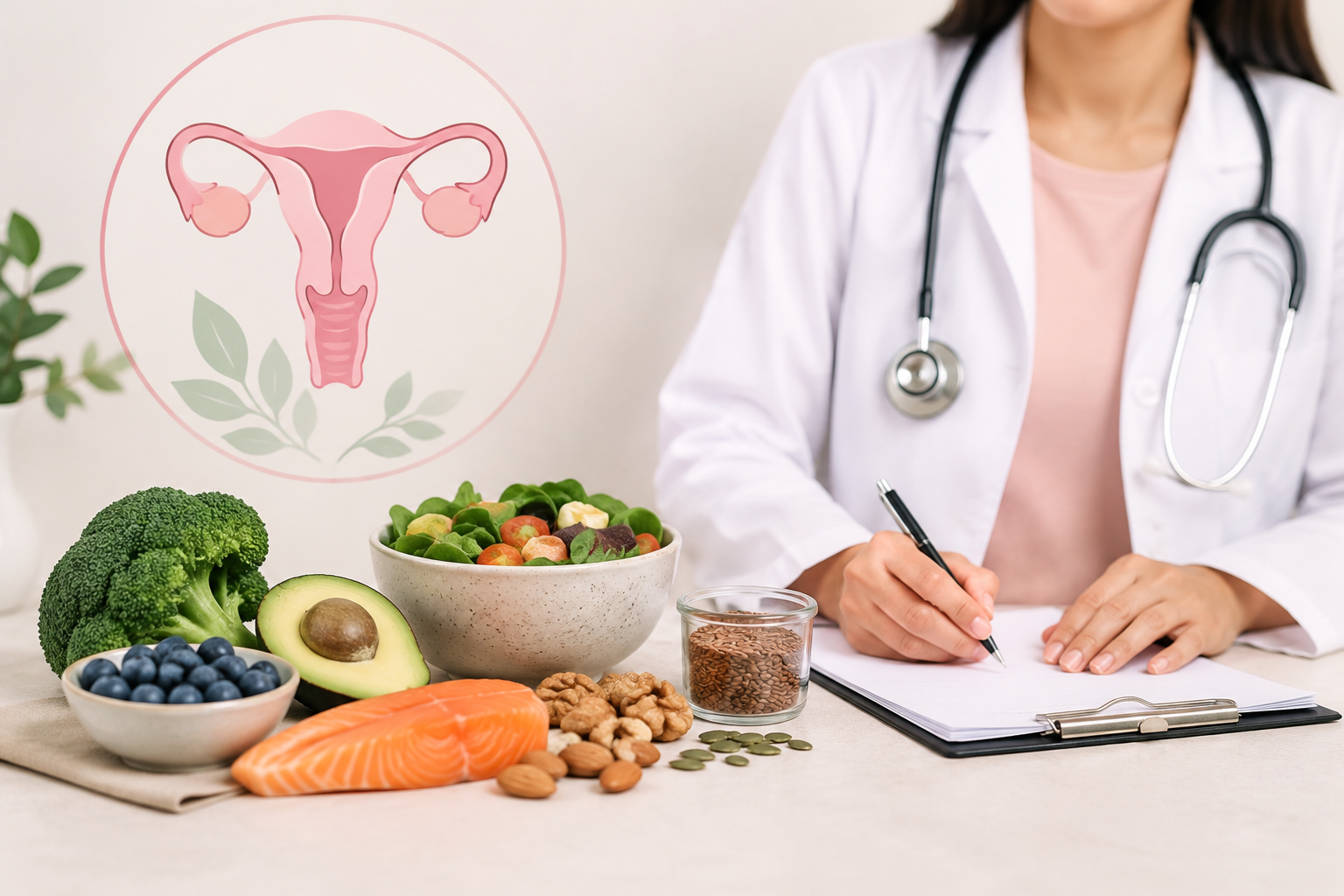
Let me be honest with you. Polycystic Ovary Syndrome (PCOS) is one of those conditions where the internet will drown you in conflicting advice — cut out dairy, eat keto, only eat between noon and 8pm. It's exhausting. So let's cut through the noise, start at the very beginning, and talk about what the science actually says — because when you understand the why, the what makes so much more sense.
PCOS affects an estimated 116 million women worldwide — roughly 1 in 10 of us. And while most people think of it as a "period problem" or a "cyst problem," it is, at its core, a metabolic and hormonal disorder in which insulin resistance sits at the very centre of the storm.
Here's what's happening beneath the surface.
Think of insulin as a key and your cells as locked doors. When you eat carbohydrates, your blood glucose rises, your pancreas releases insulin, that key unlocks the cell door, glucose rushes in, and your blood sugar returns to normal. Beautiful system. Except in PCOS, something goes wrong with the lock.
In many women with PCOS, there are defects in insulin receptor signalling at the cellular level — a kind of "sticky lock" where the key doesn't work properly. The pancreas responds by producing more insulin to compensate. The result? Chronically elevated insulin levels, known as hyperinsulinaemia.
And here's where it gets really important for your ovaries: that flood of insulin doesn't just affect your blood sugar. It inhibits Sex Hormone-Binding Globulin (SHBG) — the protein that "mops up" excess testosterone in the blood — and it directly stimulates the ovaries to produce more androgens (male hormones). This is what drives the acne, the unwanted hair growth, the irregular periods, and the difficulty ovulating.
Picture this: you eat a bowl of white rice or a sugary breakfast cereal. Your blood glucose shoots up fast — a "glucose spike." Your pancreas, already working overtime, releases a large surge of insulin. Your blood sugar then drops, often too quickly, leaving you feeling foggy, tired, irritable, and — yes — hungry again within an hour or two.
Women with PCOS also frequently struggle with leptin resistance — where the brain stops responding properly to the hormone that signals "I'm full." The result is a cruel cycle: the hunger cues don't work properly, the spikes and crashes drive cravings for more fast carbohydrates, and the pattern repeats, day after day, quietly worsening insulin resistance all along.
This cycle isn't a failure of willpower. It's biology. And once you understand it, you can start to hack it.
Let's talk about what to limit first, because it's liberating once you know the reason, not a punishment.
Refined carbohydrates and added sugars are the biggest drivers of glucose spikes in PCOS. We're talking white bread, white rice, pastries, sugary drinks, breakfast cereals, and processed snacks. These foods have a high Glycaemic Index (GI), meaning they push blood glucose up rapidly — exactly what we're trying to avoid. Low-GI diets have been shown to improve insulin sensitivity, support ovulation, and restore menstrual regularity in women with PCOS.
Ultra-processed foods and those high in trans fats and saturated fats also worsen insulin resistance and promote inflammation — and PCOS already carries a baseline of low-grade chronic inflammation.
Alcohol can further impair insulin signalling and add a hidden sugar load. It doesn't need to be eliminated forever, but it's worth being mindful of.
Here's the most underrated PCOS dietary tool: non-starchy vegetables. Leafy greens, broccoli, courgette, cucumber, capsicum, asparagus, mushrooms, cauliflower, beans, lentils — pile them on.
Why? Fibre from vegetables slows digestion, blunts the glucose spike after a meal, feeds your gut microbiome (which plays a role in insulin sensitivity), and helps with satiety without the caloric burden. Gut dysbiosis — an imbalance in gut bacteria — has been increasingly linked to the metabolic dysfunction in PCOS, and vegetables are one of the best tools we have to restore it.
Aim for at least half your plate at every meal to be non-starchy vegetables. It sounds simple. It genuinely works.
This is one of the most exciting and practical insights in recent dietary research — and you don't have to change what you eat, just the order.
Research consistently shows that consuming vegetables and protein before carbohydrates can reduce the postprandial (after-meal) glucose spike by more than 40%. In one crossover study, eating protein and vegetables first lowered the glucose peak by up to 55% compared to eating carbohydrates first.
How does this work? Eating fibre-rich vegetables and protein first slows gastric emptying, stimulates the release of GLP-1 (a gut hormone that improves insulin action), and physically coats the gut wall so that when carbohydrates arrive, they are absorbed more slowly and gently.
The practical rule is beautifully simple:
Even Stanford researchers agree: "Eat your salad or hamburger before your French fries." If you do nothing else on this list, try this one. The impact on your blood sugar — meal after meal, day after day — is significant.
In many Asian households, breakfast means rice congee, toast, noodles, or sugary cereals — all carbohydrate-heavy and low in protein. For a woman with PCOS and insulin resistance, this is one of the most impactful places to make a change.
Evidence suggests that distributing carbohydrates to later in the day (with the majority at lunch rather than breakfast) reduces insulin excursions and improves metabolic parameters. A low-carbohydrate breakfast with an emphasis on protein and healthy fat stabilises blood glucose first thing in the morning and sets the hormonal tone for the rest of the day.
Upgrade your breakfast:
No one-size-fits-all approach exists in PCOS — but the evidence consistently points to a few frameworks that work well:
The evidence strongly supports 5–6 smaller, regular meals with carbohydrates distributed throughout the day (not front-loaded at breakfast), and even modest weight loss of 5–10% significantly improves hormonal and metabolic outcomes in women with PCOS.
If PCOS shows up in adolescence — and it often does — the approach needs to be handled with particular care. Teenagers are at high risk of developing disordered eating, and restrictive language around food can do real harm.
The goal in teenage girls with PCOS is not weight loss at any cost — it's building healthy habits that support long-term metabolic health. Lifestyle promotion programmes focusing on moderate physical activity and balanced eating have been shown to improve menstrual regularity, reduce acne, and shrink waist circumference in adolescent girls with PCOS.
Early intervention matters enormously. Untreated insulin resistance in adolescence compounds metabolic risk for years to come. The framing should always be one of nourishment, not restriction: "Let's eat to feel amazing and give your hormones what they need" — not "you need to lose weight."
Priorities for teenagers:
For women trying to conceive or managing PCOS through their 20s and 30s, the stakes feel higher — and the tools are powerful. Even a weight loss of just 5% of total body weight can restore ovulation and improve fertility outcomes.
This is the time to be systematic: consistent meal timing, food sequencing at every meal, a low-GI dietary pattern, and building muscle mass through exercise. Low-carbohydrate diets (particularly low-fat/low-carbohydrate approaches) have been shown to raise SHBG and reduce testosterone — two critical changes for improving fertility and skin health.
Managing stress is also integral. Cortisol and insulin resistance have a bidirectional relationship — chronic stress worsens insulin resistance, and PCOS-related psychological burden (anxiety, depression, disordered eating) is common and real. Sleep, stress reduction, and social connection are not "soft" extras. They are metabolic medicine.
If you are trying to conceive, prioritise:
Here's what many women (and even some clinicians) don't realise: PCOS doesn't go away at menopause. What changes is the hormonal context — and for women with PCOS, the perimenopausal transition can bring a worsening of insulin resistance.
As oestrogen declines, insulin resistance deepens further — oestrogen normally has an insulin-sensitising effect. The declining progesterone and fluctuating oestrogen of perimenopause compound the already-present metabolic dysfunction of PCOS. Central adiposity (belly fat) increases, lipid profiles shift unfavourably, and the risk of metabolic syndrome becomes very real.
In essence, PCOS evolves from a reproductive disorder in the early years into a metabolic disorder as women age — and the menopause transition is a critical inflection point.
At this stage, the dietary focus shifts slightly:
I want to be clear: supplements should complement good food, not replace it. But for PCOS specifically, there are a handful where the evidence is genuinely compelling.
This is the supplement I most commonly recommend for PCOS, and the evidence supports why. Inositol acts as an insulin sensitiser — it mimics and facilitates the downstream effects of insulin at the cellular level. Myo-inositol, in particular, has been shown to restore ovulation, improve hormonal balance, and support metabolic health. The optimal supplementation ratio of myo-inositol to D-chiro-inositol is 40:1 — mimicking the ratio found in healthy women. Combined with metformin in some studies, inositol demonstrates clear clinical benefits for women undergoing ovulation induction.
Vitamin D deficiency is highly prevalent in women with PCOS and is directly linked to insulin resistance, anovulation, and infertility. Vitamin D receptors regulate over 3% of the human genome — including genes critical for glucose metabolism. Supplementation has been shown to improve insulin sensitivity, menstrual regularity, and fertility outcomes. In Singapore, despite ample sunlight, Vitamin D deficiency remains surprisingly common — so check your levels and supplement if needed (typically 1000–2000 IU daily, guided by blood levels).
Omega-3s (found in oily fish, flaxseed, and fish oil supplements) are effective at lowering fasting blood glucose and reducing the chronic inflammation that underpins PCOS. They also help correct the pro-inflammatory omega-6:omega-3 ratio that is often skewed in PCOS patients. Aim for at least 2–3 servings of oily fish per week (salmon, sardines, mackerel) or a daily omega-3 supplement of 1–2g EPA+DHA.
Magnesium plays a role in over 300 enzymatic reactions, including insulin receptor signalling. Co-supplementation of magnesium with zinc, calcium, and Vitamin D has been shown to improve insulin sensitivity, lipid profiles, and inflammatory markers in women with PCOS.
CoQ10 has emerged as particularly effective for improving lipid metabolism in PCOS — one of the most consistent findings in the umbrella meta-analysis of PCOS supplements. It is also a powerful antioxidant and may support egg quality — which is relevant in the reproductive years.
While these supplements show genuine promise, the evidence base is not yet uniform across all outcomes and all populations. Think of them as useful additions to, not substitutes for, good dietary foundations.
Exercise is not just about burning calories. For PCOS, movement is a direct insulin sensitiser — one of the few tools that genuinely improves insulin action at the cellular level independent of weight loss.
Vigorous-intensity aerobic exercise consistently reduces HOMA-IR (a measure of insulin resistance) in women with PCOS. Think brisk walking that makes you breathe hard, cycling, swimming, dancing, or jogging.
Target:
HIIT appears to offer superior improvements in insulin sensitivity and menstrual cyclicity compared to moderate continuous training. Short bursts of intense effort (20–30 seconds), followed by brief recovery, repeated for 20–30 minutes — this is time-efficient and metabolically powerful.
Building muscle is one of the most underappreciated tools in PCOS management. Skeletal muscle is the body's largest glucose sink — the more lean muscle you have, the more efficiently your body clears glucose from the blood. Resistance training has been associated with improvements in androgen levels and contributes to insulin sensitivity, especially when combined with aerobic training. Aim for muscle-strengthening exercise on at least 2 non-consecutive days per week.
For teenagers with PCOS, the guideline is at least 60 minutes of moderate-to-vigorous activity daily, including muscle- and bone-strengthening activities three times a week.
And please — find movement you actually enjoy. The best exercise for PCOS is the one you'll keep doing. Dance classes, swimming, hiking with friends, tennis, yoga (which shows early promise for androgen improvement) — it all counts.
PCOS is not a sentence. It is a metabolic tendency that responds beautifully to how you eat, move, sleep, and live. The science doesn't ask you to be perfect — it asks you to be consistent.
Eat your vegetables first. Build your breakfast around protein. Choose whole, unprocessed foods most of the time. Take your inositol and check your Vitamin D. Move your body in ways you enjoy. And be gentle with yourself — because managing PCOS is a long game, and small changes, compounded daily, genuinely transform outcomes.
Your hormones are listening to everything you eat. Make it count.
A note on evidence: All recommendations in this post are grounded in current peer-reviewed literature. They are intended as general guidance and should be individualised based on your specific PCOS phenotype, metabolic profile, and health goals. Please consult your gynaecologist or endocrinologist before starting new supplements.


© 2025 Holistic Gynaecology & Fertility. All Rights Reserved.


Monday - Friday | 09:00am - 01:00pm, 02:00pm - 05:00pm
Saturday | 09:00am - 01:00pm
Sunday & Public Holidays | Closed


