
For individuals and couples navigating fertility treatments, choosing between Mini IVF (Minimal Stimulation IVF) and Conventional IVF is one of the most pivotal decisions in their journey. While both procedures share the underlying biological principles of In Vitro Fertilization—retrieving eggs, fertilizing them in a laboratory, and transferring a viable embryo into the uterus—their approach to ovarian stimulation, protocols, medication intensity, and clinical indications differ significantly.
This detailed guide breaks down the biological, procedural, and economic differences between Mini IVF and Conventional IVF to help you understand which path aligns best with your medical history and family planning goals.
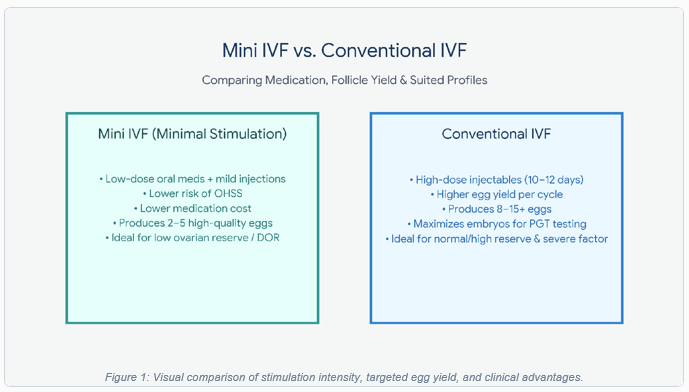
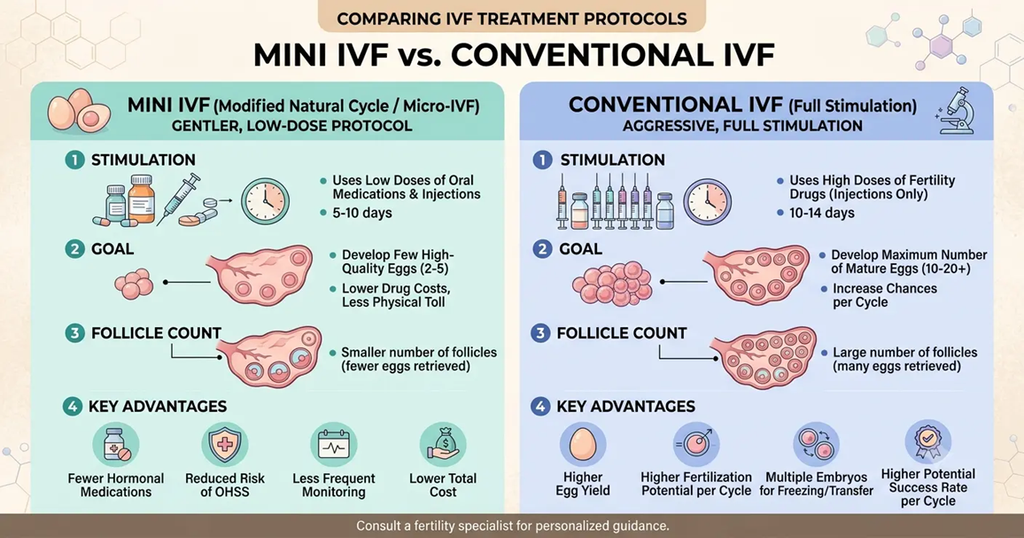
Conventional IVF aims to maximize egg yield in a single retrieval cycle. Patients undergo 10 to 12 days of high-dose injectable gonadotropins (FSH and LH) to stimulate both ovaries, coaxing multiple follicles that would normally regress to mature simultaneously. The goal is typically to retrieve 8 to 15+ mature oocytes, maximizing the downstream pool of blastocysts for fresh or frozen embryo transfers and preimplantation genetic testing (PGT).
Mini IVF, also called Minimal Stimulation or Micro IVF, focuses on egg quality over quantity. Instead of aggressive high-dose injectables, Mini IVF utilizes mild oral medications (such as Clomiphene Citrate or Letrozole) combined with low-dose injectable gonadotropins or delayed low-dose injections. The objective is to retrieve a smaller, highly curated batch of 2 to 5 high-quality oocytes while avoiding heavy physiological strain on the body.
| Feature / Parameter Mini IVF (Minimal Stimulation) Conventional IVF | ||
| Primary Goal | Quality over quantity; gentle stimulation | Maximize blastocyst yield per single cycle |
| Medication Regimen | Oral medications (Clomid/Letrozole) + minimal low-dose injections | High-dose daily injectable gonadotropins (FSH/LH) |
| Average Oocytes Retrieved | 2 – 5 mature eggs | 8 – 15+ mature eggs |
| OHSS Risk | Extremely low to virtually non-existent | Moderate to elevated (especially in PCOS patients) |
| Medication Cost | Significantly lower (up to 60–70% reduction) | Substantial (often $3,000 – $6,000+ per cycle) |
| Invasive Injections | Minimal (typically 3–5 low-dose injections) | Frequent (20–40+ injections over 10–12 days) |
| PGT-A Testing Suitability | Less ideal per single cycle (requires pooling) | Highly optimal (produces multiple embryos for screening) |
| Overall Cycle Time | Shorter, less physically taxing | Standard 4–6 week cycle timeline |
| Patient Profile / Recommended IVF Clinical Rationale Scenario Protocol | ||
| AMH < 0.5 ng/mL, AFC < 4 | Mini IVF | High-dose gonadotropins fail to recruitment extra follicles; Mini IVF offers similar egg yield at lower cost and physical stress. |
| PCOS with AMH > 5.0 ng/mL | Mini IVF or Mild Conventional | Minimizes severe OHSS risks while securing sufficient mature oocytes. |
| Age < 35, Normal Reserve, PGT Desired | Conventional IVF | Yields maximum blastocysts in one cycle, allowing for efficient PGT-A screening and freezing extra embryos. |
| Severe Tubal / Severe Male Factor | Conventional IVF | Maximizes embryo numbers to overcome downstream fertilization and development drops. |
Answer: Per individual retrieval cycle, Conventional IVF generally has higher success rates because it produces more eggs and blastocysts. However, for specific cohorts—such as women with low ovarian reserve (DOR) or advanced maternal age—Mini IVF produces comparable pregnancy rates per egg retrieved, as high medication doses do not improve egg yield in these patients.
Q2: Does Mini IVF improve egg quality?
Answer: Emerging clinical evidence suggests that mild stimulation may yield eggs that are exposed to a more natural hormonal environment, potentially reducing chromosomal abnormalities caused by hyper-stimulation in select patients. However, it does not fix age-related cellular degradation.
Answer: Depending on age and baseline fertility, patients undergoing Mini IVF often complete 2 to 3 mini-cycles to bank embryos before an embryo transfer, achieving cumulative success rates comparable to 1–2 Conventional IVF cycles.
Answer: Yes. The primary cost savings come from medication. While conventional IVF medications can cost between $3,000 and $6,000 per cycle, Mini IVF medication costs are typically between $500 and $1,500.
Answer: Yes, but it often requires embryo batching (pooling embryos across multiple Mini IVF retrieval cycles) before sending biopsies for PGT-A screening, as testing only 1 or 2 embryos per single cycle may not be cost-effective.
Neither Mini IVF nor Conventional IVF is universally superior; rather, they are tailored tools for different clinical scenarios. Conventional IVF remains the gold standard for high embryo yield and genetic screening. At the same time, Mini IVF offers an effective, gentle, and cost-efficient alternative for women with low ovarian reserve, PCOS, or those seeking a less invasive treatment path. Consult Dr. Anupriya Agarwal to conduct a complete diagnostic workup (AMH, AFC, semen analysis) to determine the ideal protocol for your body. Book your appointment now.


© 2025 Holistic Gynaecology & Fertility. All Rights Reserved.


Monday - Friday | 09:00am - 01:00pm, 02:00pm - 05:00pm
Saturday | 09:00am - 01:00pm
Sunday & Public Holidays | Closed


